Freedom, GEABSOLUTE POWERS CORRUPT ABSOLUTELY, General Election (GE15), Malaysia, Politics, polling Nov 19: Destroy Umno for the betterment of Malaysia, race, religion, Solidality, support Aliran for Justice

Share This

Showing posts with label Scams. Show all posts

Monday, 25 May 2026

Enhance fraud detection, checking banking fraud


CLICK TO ENLARGE

CLICK TO ENLARGE


Calls for improvements in detecting suspicious banking transactions

The issue has come under renewed focus following a Sessions Court ruling ordering a bank to compensate a customer RM166,000 over suspicious online transactions that went undetected.

As scams evolve, banks are facing heightened urgency to identify unusual transaction patterns and act fast, particularly as fraudsters exploit human behaviour and then move in to breach banking systems.

At a Bank Negara workshop on consumer protection and fair conduct reforms, its officers said existing laws protect the confidentiality of customer information and personal data in the financial sector.

“Financial institutions are robust but there is always room for improvements,” the officers said yesterday.

They said enforcement actions had been taken in instances where breaches were identified, including requiring the institutions involved to implement corrective action plans.

The officers also said Bank Negara continued to monitor banks on consumer protection and compliance matters.

In its latest annual report, the central bank stressed the need to strengthen fraud detection systems and reinforce internal safeguards to combat sophisticated online scams.

The central bank said banks and non-bank financial institutions were required to adopt advanced fraud detection measures and strengthen internal safeguards to quickly intercept suspicious transactions.

It also stressed for a proactive approach to prevent fraudulent transactions from escalating.

The central bank said that in recent years, financial institutions had strengthened various security measures including tighter fraud detection rules and triggers, cooling-off periods for new device registrations and stronger authentication methods.

These measures contributed to a 52% decline in unauthorised fraudulent transactions involving malware and phishing reported in 2024, and prevented over Rm399mil in attempted fraudulent transactions, it said.

However, Bank Negara also acknowledged that fraud patterns were becoming increasingly complex and harder to distinguish from genuine customer activity.

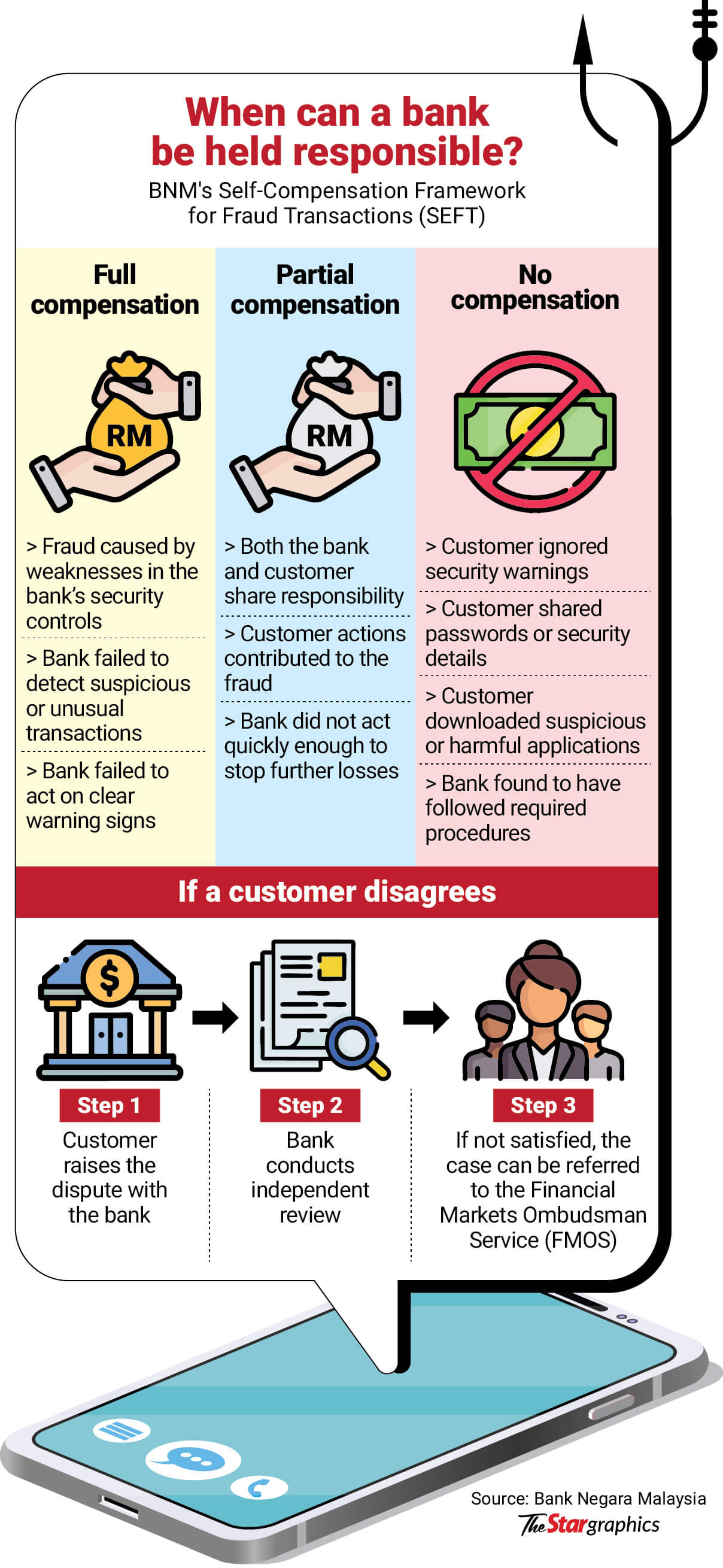
Bank Negara said banks and consumers shared responsibility for safeguarding digital banking security, but reiterated that financial institutions had to determine whether weaknesses in their internal controls contributed to fraud incidents.

It also introduced the Selfcompensation Framework for Fraud Transactions (SEFT) under its Policy Document on Ensuring Fair Treatment for Victims of Unauthorised e-banking Transactions.

SEFT outlines how banks should assess fraud cases and determine compensation based on the responsibilities of both financial institutions and customers.

According to Bank Negara, more than 95% of online fraud cases in Malaysia involved authorised transactions – where victims were manipulated into willingly transferring money to scammers.

Federation of Malaysian Consumers Associations (Fomca) vice-president Datuk Indrani Thuraisingham agreed that banks should adopt more proactive intervention measures when transactions appear inconsistent with a customer’s normal behaviour.

“Banks are clearly not doing enough. Fraudsters now exploit human behaviour more than banking systems,” she said.

“Banks must transition from passive logging to active, pre-emptive intervention.”

https://www.thestar.com.my › nation › 2026/05/22 › sle...

Related post:

Banks must rethink fraud controls as AI risks rise


Monday, 17 November 2025

When fraud pays on Facebook


 Giant greed: According to internal documents reviewed by Reuters, Meta projected that roughly 10% of its 2024 revenue – around US$16bil – came from advertisements tied to scams, banned goods and other fraudulent content. — Reuters

Fake content and scam advertisements are a bane on social media. But it gets worse when platform owners actively allow such content just to make millions.

A MONTH ago, I found a video of myself on social media promoting an investment scam promising huge returns.

I was flabbergasted and horrified. The content looked like a TV interview I had given sometime back.

The difference was that my voice had been altered, using artificial intelligence (AI) skills, to talk about investment opportunities.

The original content was on human capital and the importance of training. The modified content, using the AI version of my voice, sounded just like the real thing. It was so good it was hard to tell the difference.

I do not know why I was chosen by these scammers as I do not see my unsolicited endorsement to be of any real value.

But this is the story. I filed a complaint with Facebook on Oct 1 and they replied on Oct 8, thanking me for the report.

“We use a combination of technology and human reviewers and identify content that goes against our Community Standards. In this case, we did not remove the content that you reported,” the reply said.

As I wrote this article, I re-checked and found the content still floating around on FB, promising that “every Malaysian who invests from RM1,200 is guaranteed to earn at least RM210,000 in the first month!” It adds: “Limited spots available.”

In short, Facebook owner Meta did not see anything wrong with the fake content using my face and voice to cheat people. Meta’s reply was mind-boggling and made me feel helpless about combating such fraud.

Last week, Datuk Seri Michael Chong cautioned the public against fraudulent schemes that employ AI to replicate the faces and voices of the Prime Minister and Yang di-pertuan Agong to dupe unsuspecting individuals.

The MCA Public Service and Complaints Bureau chief said he had identified two online advertisements featuring the PM and King. When they were reported, the ads were removed, but the syndicate had re-uploaded similar content, this time using the face sofa nm panda prominent business figure.

Using AI, the syndicate created investment advertisements requiring a payment of RM1,100 while promising returns of up to RM200,000.

Why did Facebook fail to act? Well, we may know now. An investigation by Reuters has cast a harsh light on the business practices of Meta Platforms Inc, the parent company of Facebook, Instagram, and Whatsapp.

According to internal documents reviewed by Reuters, Meta projected that roughly 10% of its 2024 revenue – around Us$16bil (Rm66.72bil) – came from advertisements tied to scams, banned goods, and other fraudulent content.

What is deeply troubling is that the documents suggest that Meta’s enforcement efforts against these bad actors were intentionally limited, constrained by “revenue guardrails” and automated systems that only block ads when there is at least a 95% certainty of fraud.

For Malaysia and for users of social media everywhere, the implications are profound.

This is not just about one tech giant’s failure; it is about the structural tensions between platform profit models and user protection, and the regulatory void that allows serious harm to happen.

In Malaysia, the Malaysian Communications and Multimedia Commission has already expressed alarm, noting that some of that revenue could stem from Malaysian-market ads, and has summoned Meta for answers.

Allowing platforms to be used for such scams and profiting from it makes Meta an accomplice to such cybercrimes.

These platforms should be held to account for the content they host and monetise.

If a platform is earning money from fraud-linked ads, that raises questions of complicity, not just oversight failure.

When a company’s business model allows or even subtly incentivises questionable advertisers, that means it does not value ethics.

It has been reported that Meta internally estimated the scale of “high-risk” scam advertisements at Us$15bil (Rm61.9bil) of such ads per day across its platforms.

The company’s justification is that it will only block advertiser accounts when automated systems are 95% sure the advertiser is engaging in fraud.

If it is not absolutely certain, it just charges them higher ad rates – effectively profiting from uncertainty.

In my case, despite my protest, we can assume that Meta did not find enough evidence that it was a fraud.

It was a case of “looks like you, sounds like you but we are not sure it’s a fraud despite your complaint”.

A Reuters report on Nov 11 said that “Meta knowingly profits off of them” – meaning the social media giant knew about ads for fake products and scam posts and projected that it could earn up to Us$16bil from running these ads featuring banned goods or scamming posts.

Meta is so powerful that it can snub protests and calls from regulators requiring it to publish clear data on scam advertising volumes and the ad revenue derived from them.

If the company doesn’t have any ethics why would it care two hoots about accountability? It knows the world is addicted to its products.

Responsibility does not seem to exist in the company statement.

The only way out is to teach Malaysians how to identify scam ads, report suspicious content, and hold platforms and advertisers to account.

Digital literacy is a frontline defence, and also, simply stop being greedy. If it sounds too good to be true, then it’s a scam.

Meta knows we are hooked on Whatsapp, Instagram and Facebook, and the world will not function a day without these products. It is untouchable.

We have miserably consented and surrendered all our personal data to Meta to use these products for free.

Now you know why and how these scammers get our details. Meta is enriching itself, and each time regulators want to haul it up, it cries that it’s an assault on the platforms.

Wong Chun Wai

Wong Chun Wai

Wong Chun Wai began his career as a journalist in Penang, and has served The Star for over 35 years in various capacities and roles. He is now group editorial and corporate affairs adviser to the group, after having served as group managing director/chief executive officer. On The Beat made its debut on Feb 23 1997 and Chun Wai has penned the column weekly without a break, except for the occasional press holiday when the paper was not published. In May 2011, a compilation of selected articles of On The Beat was published as a book and launched in conjunction with his 50th birthday. Chun Wai also comments on current issues in The Star.

When fraud pays on Facebook


 Giant greed: According to internal documents reviewed by Reuters, Meta projected that roughly 10% of its 2024 revenue – around US$16bil – came from advertisements tied to scams, banned goods and other fraudulent content. — Reuters

Fake content and scam advertisements are a bane on social media. But it gets worse when platform owners actively allow such content just to make millions.

A MONTH ago, I found a video of myself on social media promoting an investment scam promising huge returns.

I was flabbergasted and horrified. The content looked like a TV interview I had given sometime back.

The difference was that my voice had been altered, using artificial intelligence (AI) skills, to talk about investment opportunities.

The original content was on human capital and the importance of training. The modified content, using the AI version of my voice, sounded just like the real thing. It was so good it was hard to tell the difference.

I do not know why I was chosen by these scammers as I do not see my unsolicited endorsement to be of any real value.

But this is the story. I filed a complaint with Facebook on Oct 1 and they replied on Oct 8, thanking me for the report.

“We use a combination of technology and human reviewers and identify content that goes against our Community Standards. In this case, we did not remove the content that you reported,” the reply said.

As I wrote this article, I re-checked and found the content still floating around on FB, promising that “every Malaysian who invests from RM1,200 is guaranteed to earn at least RM210,000 in the first month!” It adds: “Limited spots available.”

In short, Facebook owner Meta did not see anything wrong with the fake content using my face and voice to cheat people. Meta’s reply was mind-boggling and made me feel helpless about combating such fraud.

Last week, Datuk Seri Michael Chong cautioned the public against fraudulent schemes that employ AI to replicate the faces and voices of the Prime Minister and Yang di-pertuan Agong to dupe unsuspecting individuals.

The MCA Public Service and Complaints Bureau chief said he had identified two online advertisements featuring the PM and King. When they were reported, the ads were removed, but the syndicate had re-uploaded similar content, this time using the face sofa nm panda prominent business figure.

Using AI, the syndicate created investment advertisements requiring a payment of RM1,100 while promising returns of up to RM200,000.

Why did Facebook fail to act? Well, we may know now. An investigation by Reuters has cast a harsh light on the business practices of Meta Platforms Inc, the parent company of Facebook, Instagram, and Whatsapp.

According to internal documents reviewed by Reuters, Meta projected that roughly 10% of its 2024 revenue – around Us$16bil (Rm66.72bil) – came from advertisements tied to scams, banned goods, and other fraudulent content.

What is deeply troubling is that the documents suggest that Meta’s enforcement efforts against these bad actors were intentionally limited, constrained by “revenue guardrails” and automated systems that only block ads when there is at least a 95% certainty of fraud.

For Malaysia and for users of social media everywhere, the implications are profound.

This is not just about one tech giant’s failure; it is about the structural tensions between platform profit models and user protection, and the regulatory void that allows serious harm to happen.

In Malaysia, the Malaysian Communications and Multimedia Commission has already expressed alarm, noting that some of that revenue could stem from Malaysian-market ads, and has summoned Meta for answers.

Allowing platforms to be used for such scams and profiting from it makes Meta an accomplice to such cybercrimes.

These platforms should be held to account for the content they host and monetise.

If a platform is earning money from fraud-linked ads, that raises questions of complicity, not just oversight failure.

When a company’s business model allows or even subtly incentivises questionable advertisers, that means it does not value ethics.

It has been reported that Meta internally estimated the scale of “high-risk” scam advertisements at Us$15bil (Rm61.9bil) of such ads per day across its platforms.

The company’s justification is that it will only block advertiser accounts when automated systems are 95% sure the advertiser is engaging in fraud.

If it is not absolutely certain, it just charges them higher ad rates – effectively profiting from uncertainty.

In my case, despite my protest, we can assume that Meta did not find enough evidence that it was a fraud.

It was a case of “looks like you, sounds like you but we are not sure it’s a fraud despite your complaint”.

A Reuters report on Nov 11 said that “Meta knowingly profits off of them” – meaning the social media giant knew about ads for fake products and scam posts and projected that it could earn up to Us$16bil from running these ads featuring banned goods or scamming posts.

Meta is so powerful that it can snub protests and calls from regulators requiring it to publish clear data on scam advertising volumes and the ad revenue derived from them.

If the company doesn’t have any ethics why would it care two hoots about accountability? It knows the world is addicted to its products.

Responsibility does not seem to exist in the company statement.

The only way out is to teach Malaysians how to identify scam ads, report suspicious content, and hold platforms and advertisers to account.

Digital literacy is a frontline defence, and also, simply stop being greedy. If it sounds too good to be true, then it’s a scam.

Meta knows we are hooked on Whatsapp, Instagram and Facebook, and the world will not function a day without these products. It is untouchable.

We have miserably consented and surrendered all our personal data to Meta to use these products for free.

Now you know why and how these scammers get our details. Meta is enriching itself, and each time regulators want to haul it up, it cries that it’s an assault on the platforms.

Wong Chun Wai

Wong Chun Wai

Wong Chun Wai began his career as a journalist in Penang, and has served The Star for over 35 years in various capacities and roles. He is now group editorial and corporate affairs adviser to the group, after having served as group managing director/chief executive officer. On The Beat made its debut on Feb 23 1997 and Chun Wai has penned the column weekly without a break, except for the occasional press holiday when the paper was not published. In May 2011, a compilation of selected articles of On The Beat was published as a book and launched in conjunction with his 50th birthday. Chun Wai also comments on current issues in The Star.