Freedom, GEABSOLUTE POWERS CORRUPT ABSOLUTELY, General Election (GE15), Malaysia, Politics, polling Nov 19: Destroy Umno for the betterment of Malaysia, race, religion, Solidality, support Aliran for Justice

Share This

Showing posts with label nutrition. Show all posts

Sunday, 19 July 2026

Seven healthy foods for your brain


Photo: Magnific

These dif­fer­ent foods have dif­fer­ent prop­er­ties and com­pounds that can enhance brain health in dif­fer­ent ways.

New research suggests that a structured programme that combines regular exercise with a brain-friendly diet may help improve memory and thinking skills in older adults who are at a higher risk of dementia.

The two-year study followed more than 1,000 adults aged between 60-77 across 11 Latin American countries who had risk factors such as high blood pressure, high cholesterol or smoking.

Half the participants completed supervised exercise four times a week, received personalised brain-healthy nutrition advice and took part in cognitive training, social activities and regular health monitoring.

The comparison group, meanwhile, received general health advice and attended four one-hour meetings over the two years. 

Researchers found that those following the structured programme performed better in cognition, episodic memory, executive function and procession speed tests, suggesting that lifestyle changes may help protect cognitive health. 

Here are their top seven recommendations:

1. Brazil nuts

Make nuts your new go-to brain-boosting snack.

“Healthy fats give brain cells structure and function, so I would recommend adding nuts to your shopping list,” suggests British dietitian Lesley Reid.

She recommends Brazil nuts in particular, because as well as containing all the healthy fats, they are also rich in selenium, which is a powerful antioxidant that is great for the brain.

“Have no more than three Brazil nuts per day because they’re pretty powerful,” she advises.

“Have them raw as a snack, or chop them up and mix them through a yoghurt.”

2. Chickpeas

Getting enough protein is also vital for brain health.

“We want to make sure we eat enough good protein sources because proteins are broken down into amino acids, and amino acids are the building blocks of all our cells,” explains Reid.

She adds that amino acids play a particularly important role in neurotransmitters, which make connections in the brain.

Many people think of protein shakes, meat and eggs when it comes to protein, but chickpeas are a great underrated source.

“Tins of chickpeas are a really good source of protein which are pretty cheap,” she says.

“You could roast them, add them to a salad, or blend them up and make them into a hummus to have with bread or as a dip with vegetables.”

3. Blueberries

“One colour of the rainbow that we are often missing from our diet is dark purple, and purple foods like blueberries are another great thing to add to your shopping list,” says Reid.

Blueberries are bursting full with brain-boosting properties, including flavonoids such as anthocyanins and quercetin.

“Research suggests that anthocyanins reduce brain inflammation, stimulate the growth of new brain cells and improve blood flow to the areas responsible for memory and focus,” says British nutritionist Priya Kannath.

“In addition, quercetin is a natural anti-inflammatory compound that helps protect brain cells from damage caused by everyday oxidative stress.”

Frozen blueberries are great because they last much longer than fresh ones.

“You can add them into smoothies, have them with porridge or blitz them with some yoghurt,” she recommends.

4. Green leafy vegetables

“Green leafy vegetables, such as kale and spinach, are rich in magnesium, high in B vitamins and are really good at supporting your energy production and nervous system function,” says Reid.

“They are also very high in vitamin C and offer that antioxidant protection, so are really good for brain function.”

Leafy greens are incredibly versatile and can be incorporated into your diet in many different ways.

“You could steam them, add them into curries, soups and casserole dishes.

“You could also add them into a quiche or into a green smoothie,” suggests Kannath.

5. Oily fish

“Research suggests that higher omega-3 intake has been linked to lower levels of beta amyloid proteins that are associated with Alzheimer’s disease,” says Kannath.

She notes that oily fish, such as sardines and salmon, are a great source of omega-3 fatty acids.

“I would recommend aiming for at least two portions of oily fish a week to get that omega-3 support,” she suggests.

“Canned fish is particularly great because it contains the softened bones of the fish, which will give an extra boost of vitamin D and calcium.

“However, if you prefer buying fresh or frozen fish, you could bake it, make a curry or grill it.”

6. Dark chocolate

“The more cocoa dark chocolate contains, the better it is,” says Kannath.

“Dark chocolate contains flavonoids – such as epicatechin, catechins and procyanidins – that can support cognitive function and also improve the blood flow to the brain.”

She recommends choosing a dark chocolate that is at least 70% cocoa.

“l would recommend eating a square of dark chocolate a day after your evening meal,” she says.

7. Extra virgin olive oil

“Extra virgin olive oil contains anti-inflammatory properties that can help support vascular health which is central to brain health,” says Kannath.

“I would recommend drizzling a little bit of extra virgin olive oil over a salad.” – PA Media/dpa

Wednesday, 15 July 2026

Here's how to dine on durian wisely

 It’s hard to stop at just a few pieces of durian, but if you keep going, it can easily add up to another entire meal’s worth of calories. — LIM BENG TATT/The Star 

Two durian pieces fine, 15 equal to a meal, says dietitian

When durian season arrives, many Malaysians do not eat durian like fruit, they consume it like a feast.

If six apples were placed on the table, most people would not finish all six at one sitting.

The same goes for eight oranges or 10 bananas, for example.

But when it comes to durian, “just one more piece” can easily become 10, 15, or even 20 pieces (or seeds), before anyone realises it.

The issue is not that durian is “bad”. The real issue is portion size.

After 15 pieces

A recent personal observation using a continuous glucose monitor (CGM) showed how much portion size can matter.

A CGM is a small sensor that tracks glucose levels throughout the day.

Before eating the durian, the glucose reading was 4.9 mmol/L.

After consuming 15 pieces of durian, the reading rose to 8.0 mmol/L within an hour.

It peaked at 9.1 mmol/L after about 90 minutes before gradually coming down over the next few hours.

If blood glucose had only been checked before eating and two hours after eating, the result may not have looked alarming.

But the CGM showed the full journey: how high the glucose climbed, how long it stayed elevated, and how much work the body had to do to bring it back down.

This was only an individual observation, not a clinical study, and glucose response can differ from person to person.

However, it is a useful reminder that blood glucose response is not only about the type of food we eat, but also about the total portion we consume.

The glucose did not rise because of one piece; every extra piece contributed to the total glucose load the body had to manage.

Each piece of durian adds more carbohydrate for the body to process.

The body then releases insulin to help move glucose from the bloodstream into the muscles and liver to be used or stored as energy.

When calorie intake repeatedly exceeds what the body needs, the excess energy may contribute to weight gain over time.

Every additional piece means more glucose to manage, more insulin to release and more calories to handle.

Durian nutrients

An average piece of durian, weighing about 27g, contains approximately 45 kcal and 8g of carbohydrate.

At the same time, durian also provides dietary fibre, potassium, vitamins B and C, and beneficial antioxidants.

In other words, durian is still a fruit that provides good nutrients.

Like every other fruit, it has a recommended serving size.

Malaysians are generally encouraged to consume two servings of fruit daily, and durian can fit into this recommendation when eaten in the right portion.

For example, one serving of fruit looks like this:

  • One medium apple
  • One small banana
  • One medium orange
  • One slice of papaya
  • Two average-sized pieces of durian.

Two average-sized pieces of durian provide about 90 kcal and 16g of carbohydrates.

This can still be considered a moderate-sized snack portion.

That is why two average-sized pieces of durian can be considered one serving of fruit.

‘Just one more piece’

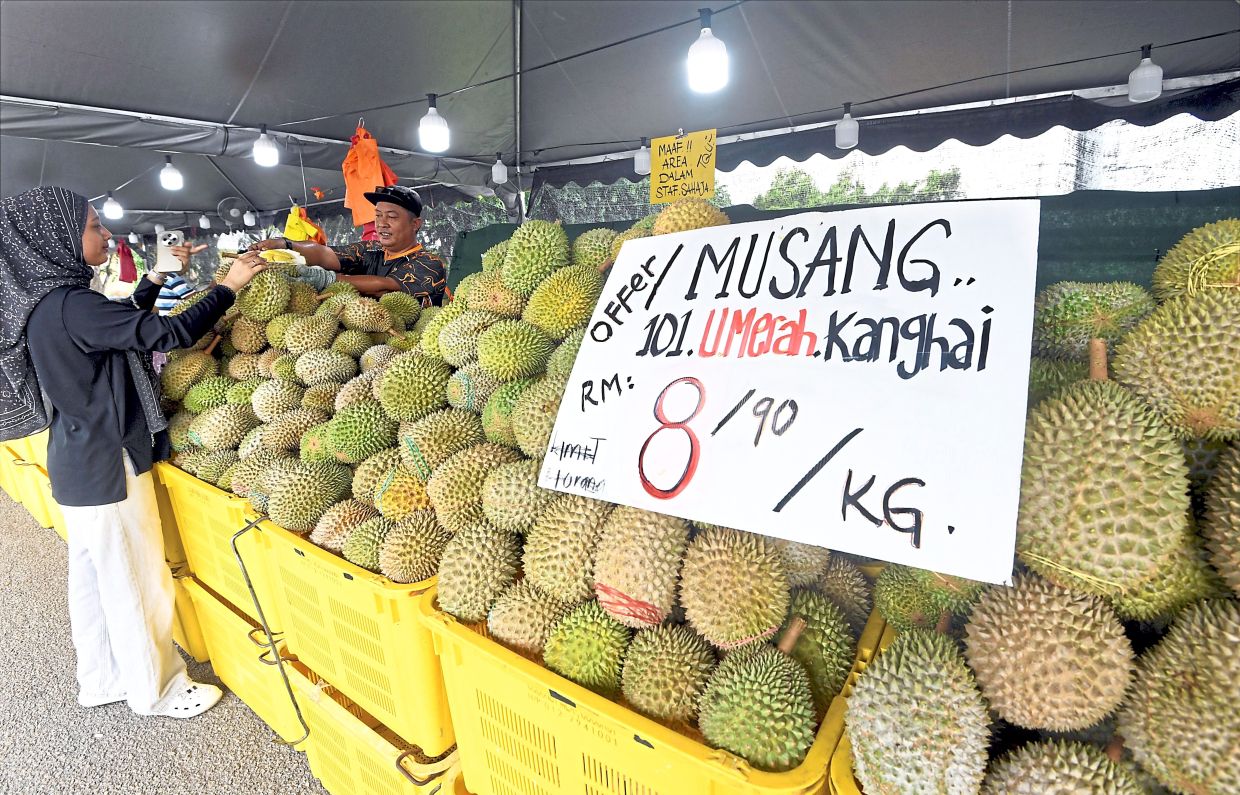
The current cheaper prices of durian makes it even harder to limit consumption for durian lovers. — AZHAR MAHFOF/The Star

The problem is not consuming the two pieces of durian; the problem is that durian is rarely limited to just two pieces.

Below are the amount of calories and carbohydrates for different amounts of durian:

  • One piece: 45 kcal and 8g
  • Five pieces: 225 kcal and 40g
  • 10 pieces: 450 kcal and 80g
  • 15 pieces: 675 kcal and 120g.

For comparison, a typical Malaysian lunch or dinner may provide around 500 kcal and 60g of carbohydrate, depending on food choices and portion size.

Now, imagine enjoying 10, or even 15, pieces of durian.

Without realising it, those “just one more piece” moments can quietly add another entire meal’s worth of calories and carbohydrates to your daily food intake.

Durian is generally considered a low to medium glycaemic index (GI) fruit.

Because of this, some people may assume it can be eaten freely.

ALSO READ: Understanding the glycaemic index

However, the glycaemic index of a food is only one part of the picture.

The bigger concern during durian season is glycaemic load, which refers to the total amount of carbohydrates consumed.

One or two pieces may be manageable for many people.

But 10 or 15 pieces create a much higher glucose load for the body to manage.

This is especially important for people living with diabetes, prediabetes, insulin resistance, weight concerns or a family history of diabetes.

Eat wisely

Still, Malaysians do not need to avoid durian completely.

Food should not be about fear; durian can still be enjoyed.

The key is to enjoy it with better awareness and a more mindful portion, especially when it is eaten after a full meal:

  • Keep to about two average- sized pieces as one fruit serving.
  • Avoid eating a large amount of durian immediately after a heavy rice-based meal.
  • Share with family or friends instead of finishing one box or fruit alone.
  • Eat slowly and enjoy the taste, instead of turning it into a challenge.

For people with diabetes, prediabetes or other health concerns, monitoring your blood glucose response and seeking personalised advice from a dietitian or healthcare professional can help support better food choices.

Durian season is something many Malaysians look forward to.

The goal is not to stop people from enjoying durian, but to help everyone enjoy it with better awareness.

Khoo Wei Jin is a dietitian at Alpro Pharmacy. For more information, email starhealth@thestar.com.my. The information provided is for educational and communication purposes only, and should not be considered as medical advice. The Star does not give any warranty on accuracy, completeness, functionality, usefulness or other assurances as to the content appearing in this article. The Star disclaims all responsibility for any losses, damage to property or personal injury suffered directly or indirectly from reliance on such information.

Related stories:


Two durian pieces fine, 15 equal to a meal, says dietitian 

Wednesday, 21 May 2025

Could vitamin E help promote longevity?


Palm oil and rice bran-derived products are major sources of tocotrienols in our diet. — Hovid

The journey of vitamin E research began in the early 20th century, with tocopherols being the first forms identified and studied for their nutritional significance.

Initially regarded as essential for reproductive health, vitamin E gradually garnered attention for its antioxidant properties.

As research progressed, scientists discovered tocotrienols, which were found to possess superior antioxidant capabilities compared to their tocopherol counterparts.

Characterised by unsaturated side chains, tocotrienols contribute to distinct biological activities.

This revelation led to a surge of interest in tocotrienols, prompting investigations into their potential to prevent chronic diseases and promote overall wellness.

Health benefits

The health benefits of tocotrienols are extensive and diverse.

Research suggests that tocotrienols may help lower cholesterol levels, reduce inflammation and protect against neurodegenerative diseases.

They have been associated with:

Antioxidant properties

One of the most notable characteristics of tocotrienols is their potent antioxidant activity.

Antioxidants are vital for neutralising free radicals – unstable molecules that can cause oxidative stress and lead to cellular damage.

Tocotrienols have been shown to be significantly more effective than their tocopherol counterparts in scavenging free radicals.

This enhanced antioxidant capacity helps protect cells from oxidative damage, potentially reducing the risk of chronic diseases and supporting overall health.

By mitigating oxidative stress, tocotrienols may contribute to the prevention of conditions such as cancer, diabetes and neurodegenerative diseases.

Cardiovascular (heart) health

Tocotrienols have also been extensively studied for their cardiovascular benefits.

Research indicates that these compounds can help lower cholesterol levels, improve arterial health and reduce inflammation – all critical factors in maintaining heart health.

Tocotrienols may inhibit the synthesis of cholesterol in the liver, leading to lower levels of low-density lipoprotein (LDL) cholesterol, often referred to as “bad” cholesterol.

Additionally, their anti-inflammatory properties can reduce the risk of atherosclerosis – a condition characterised by the build-up of plaque in the arteries, which can lead to heart attacks and strokes.

By promoting better lipid profiles and reducing inflammation, tocotrienols play an essential role in supporting cardiovascular health.

Neuroprotective effects

Emerging research suggests that tocotrienols may offer significant neuroprotective benefits, making them promising candidates for supporting brain health and cognitive function.

Studies have indicated that tocotrienols can help protect neurons from oxidative stress, which is implicated in various neurodegenerative disorders such as Alzheimer’s and Parkinson’s diseases.

Their ability to cross the blood-brain barrier allows tocotrienols to exert protective effects directly on brain cells.

Furthermore, tocotrienols may enhance cognitive function and memory, potentially offering a natural approach to preventing age-related cognitive decline.

As the global population ages, the neuroprotective properties of tocotrienols could prove invaluable in promoting longevity and maintaining quality of life.

Cellular longevity

The role of tocotrienols in cellular health also extends to the maintenance of telomeres – the protective caps at the ends of chromosomes – which are pivotal in cellular ageing and longevity.The antioxidant properties of tocotrienols, as well as its support of telomerase activity, could be what helps slow the ageing of our cells.The antioxidant properties of tocotrienols, as well as its support of telomerase activity, could be what helps slow the ageing of our cells.

Composed of repetitive nucleotide sequences, telomeres play a crucial role in maintaining genomic stability by preventing the degradation of genetic material during cell division.

Each time a cell divides, its telomeres shorten, which is a natural part of the ageing process.

When telomeres become critically short, cells enter a state known as senescence, where they can no longer divide.

This process is linked to various age-related diseases and overall longevity.

Factors such as stress, poor diet and lack of physical activity can accelerate telomere shortening, while healthy lifestyle choices may help preserve telomere length and promote longevity.

Emerging research also suggests that tocotrienols may play a significant role in the maintenance and preservation of telomeres, thereby contributing to cellular longevity.

Their antioxidant properties can help protect cells from oxidative stress, a major contributor to telomere shortening.

By neutralising free radicals and reducing oxidative damage, tocotrienols may help slow down the rate of telomere attrition.

In addition to their antioxidant capabilities, tocotrienols have been shown to modulate various signalling pathways involved in cell growth and survival.

Some studies indicate that tocotrienols can enhance the expression of telomerase – an enzyme that adds nucleotide sequences to the ends of telomeres – thus potentially counteracting the natural shortening that occurs during cell division.

This dual action of protecting against oxidative damage and supporting telomerase activity positions tocotrienols as promising candidates for promoting telomere health, and by extension, longevity.

Incorporating tocotrienols

Tocotrienols are primarily found in:

  • Palm oil – especially red palm oil, which is rich in both tocotrienols and tocopherols
  • Rice bran oil – from rice grains
  • Barley – from its bran
  • Wheat germ – a nutrient-dense oil source
  • Nuts and seeds – especially hazelnuts and sunflower seeds.

Supplements are also available – often derived from palm or rice bran oil – to help meet intake needs.

While no established daily value exists, studies suggest a daily intake of 100-300mg for health benefits.

Tocotrienol supplements can be found as:

  • Softgel capsules – convenient for consistent dosing
  • Powders – easily mixed into foods.
  • Liquid extracts – providing flexible consumption options.

Do consult a healthcare professional before starting supplements, especially for those pregnant or on medication.

Here are some practical tips on how to incorporate tocotrienols into your diet:

  • Cooking with oils – use red palm or rice bran oil for enhanced flavour and intake
  • Adding whole grains – include barley or whole grain products in your meals
  • Snacking smart – choose nuts and seeds for healthy snacks
  • Supplements – consider tocotrienol supplements if dietary intake is insufficient
  • Diversifying meals – create meals with various tocotrienol sources for nutrition and flavour.

In summary, tocotrienols could provide the bridge between nutrition and longevity, offering significant health ­benefits that merit attention from both science and the public.

Continued research is essential to fully realise their potential in promoting well-being.

Datuk Dr Nor Ashikin Mokhtar is a consultant obstetrician and ­gynaecologist, and a functional medicine practitioner. For further information, email starhealth@thestar.com.my. The information ­provided is for educational and communication purposes only, and it should not be construed as ­personal medical advice. Information published in this article is not intended to replace, supplant or augment a consultation with a health professional regarding the reader’s own medical care. The Star does not give any warranty on accuracy, completeness, ­functionality, usefulness or other assurances as to the content appearing in this column. The Star disclaims all responsibility for any losses, damage to property or personal injury suffered directly or indirectly from reliance on such information.

Source link

Related stories: