Freedom, GEABSOLUTE POWERS CORRUPT ABSOLUTELY, General Election (GE15), Malaysia, Politics, polling Nov 19: Destroy Umno for the betterment of Malaysia, race, religion, Solidality, support Aliran for Justice

Share This

Showing posts with label Competition. Show all posts

Sunday, 4 January 2026

China racing ahead in Britain


Keith’s BYD car dealership in Leeds, England. In the last year, Chinese-made vehicles have doubled their share of new car registrations in Britain. — Owen Richards/The New York Times

ON a recent Monday in Leeds, Dougal Keith drove a Chinese-made BYD Seal Excellence out of his dealership and hit the accelerator.

The car can reach 100kph in 3.8 seconds – a key selling point – and comes with a £48,000 price tag, roughly 20% cheaper than a top-range Tesla Model 3.

Keith, a car salesman for more than 40 years, said customers were sceptical of buying Chinese vehicles when he opened a showroom for BYD in 2023.

Now, he runs six dealerships devoted to the brand.

“Some people think because it’s Chinese it’s made cheaply,” he said. “But then I ask, ‘Where do you think your iphone is assembled?’”

Chinese cars are gaining ground in Britain for a mix of reasons.

There are no steep tariffs on Chinese EVS – unlike in the EU or the US – allowing lower prices. British buyers are also less brand-loyal, with no major domestic mass-market automaker to defend.

Roughly a dozen Chinese brands, including BYD, Chery and Geely, made up 13% of new car registrations in Britain in November, double their share a year ago, according to the Society of Motor Manufacturers and Traders.

“The pace is like nothing the market has ever seen,” said Ian Plummer, chief commercial officer of Autotrader.

BYD and Chery, selling Jaecoo and Omoda models, are gaining market share five or six times faster than Tesla a decade ago or South Korea’s Kia in the 1990s.

Britain’s domestic auto industry has been shrinking, producing about 600,000 cars in 2025, roughly half of the output at the end of the last decade.

Major producers include Nissan, Jaguar Land Rover and Mini.

Meanwhile, China is now the world’s largest car exporter and leads in EV production, exporting to markets from Mexico to South Africa.

Chinese automakers have mastered shifting regulations and consumer demand, particularly for hybrids.

Beijing encourages exports to manage domestic overcapacity, sometimes leading to heavy losses and triggering pushback in Western countries.

The US has imposed 100% tariffs on Chinese EVS, the EU up to 45%, while Britain charges 10% on all imported cars.

About two million new cars are sold in Britain each year.

Since 2019, the number of brands registering sales has nearly doubled to over 70.

No single brand commands loyalty like Volkswagen in Germany or Renault in France, giving newcomers room to grow.

Chinese brands first gained a foothold with SAIC Motor’s acquisition of MG.

Production gradually moved to China, and the UK MG factory closed in 2016.

MG now accounts for over 4% of new registrations – the largest share for a Chinese-owned brand – while BYD holds just over 2%, similar to Tesla.

Keith sold his first car in 1980 at 16 and later expanded his family business.

By the early 2020s, he noticed BYD and,

“Some people think because it’s Chinese it’s made cheaply. But then I ask, ‘Where do you think your iphone is assembled?’”
Dougal Keith

with other independent dealers, secured one of the first UK franchises.

Initially, sales were slow, with only an all-electric model available.

As more models arrived, particularly plug-in hybrids, sales surged.

Dealers highlighted tech features: rotatable touch screens, wireless chargers, voice controls, even karaoke.

“Customers are beginning to understand it’s not a budget brand,” said Fozia Siddique, who has worked with BYD since the Leeds showroom opened.

She recently sold a BYD plug-in hybrid SUV to Steve Vine, 55, who drives more than 480km from Leeds to Cornwall and wanted a long-range EV.

Roger Lyons, 60, in Derbyshire, chose a £48,000 BYD Seal Excellence after testing Audi, Hyundai and Porsche models.

“It’s almost as nice to drive as a Porsche, and it’s got more toys than any of the others,” he said, adding that switching to electric would help cut fuel costs.

Encouraged by the success of BYD, Keith opened two more dealerships selling Changan vehicles.

His group, which runs 28 dealerships selling global brands, expects £500mil in sales for 2025, over 50% higher than 2024.

In September, the Leeds BYD showroom outsold all his other local locations.

“It’s pretty good going for a brand that two years ago nobody had heard of,” he said. — ©2026 The New York Times Company

By ESHE NELSON This article originally appeared in The New York Times
3 Jan 2026

Wednesday, 31 December 2025

Tech war endgame


THROUGHOUT this year, the most incessant and pernicious concern most countries share has been Washington’s “reciprocal” tariffs.

The fact that Donald Trump hit the whole world with tariffs since returning to office in January assured him of global attention, but of the negative sort.

Grabbing world headlines while confounding critics was classic Trump. The surprise came in how spiralling US tariffs against China were abruptly deflected onto the rest of the world instead.

That resulted from what must have been a surprise to the Trump administration itself: tariffs on China were suddenly halted in their tracks when Beijing hit back with counter-tariffs of its own.

Moral of the story: respond innovatively, don’t just succumb. Pull some surprises of your own.

Trump 2.0’s tariffs had another unintended consequence – lumping allies, partners and everyone else together with its perceived adversaries. This assertion of hard power came at the expense of its soft power and international credibility.

The US had underestimated China’s capacity again. Multiple examples abound of how two can play Trump’s game of trade shock and awe.

This is by now a standard principle of Us-china rivalry: squeeze Beijing hard, and get an unintended and opposite effect. The lesson was never learned – tariffs, sanctions and bans have only spurred China to achieve more and grow stronger.

From its own International Space Station Tiangong and the world’s first moon landing on the far side to breakthroughs in quantum computing and nuclear fusion technology, China’s gains have multiplied when challenged. And the US appears all set to continue this unwitting “assistance”.

The Deepseek moment when China achieves equivalent or better success with higher value, in less time, and at lower cost has become almost routine. Deepseek itself was followed by Moore Threads, whose billion-dollar status, early IPO and massive oversubscription on opening day thrashed all its Western peers by a stunning factor of several thousand.

Among China’s more recent technological feats is Shenzhen’s Extreme Ultra-violet (EUV) lithography prototype. This triumph against the odds came despite, or rather because of, the US ban on sales of EUV machines to China.

It followed the familiar and flawed assumption that China cannot build competitive technology of its own. This myth persists despite repeated warnings from tech industry leaders in the West.

Former ASML CEO Peter Wennink had predicted that Us-led Western pressure against China’s technological development would only backfire by massaging its STEM prowess. Nvidia CEO Jensen Huang observed that China was only ‘nanoseconds’ behind in making the world’s most advanced chips.

Nvidia designs high-end chips made by Taiwan’s TSMC with ASML’S EUV equipment from the Netherlands. The US has tried hard to keep China out of this vital supply chain, but with steadily diminishing success.

Such futility stems from failure to appreciate the interconnectedness of global industry and all its implications, and not least China’s already considerable capacity galvanised by its irrepressible will to succeed. The condescending attitude that “China can only copy, not innovate” adds to its determination to beat all the odds.

Prior to China’s launch of the Asian Infrastructure Investment Bank (AIIB) a decade ago, US cynics said China had nobody competent to run it. But it appointed founding President Jin Liqun, a respected professor and senior veteran of the World Bank, the Asian Development Bank and China’s Finance Ministry.

It happened again with Deepseek and Moore Threads, under their founding CEOS Liang Wenfeng and James Zhang. Since the Western commentariat had not heard of them, the capacity they represented was deemed non-existent.

Yet a 23-year-old Liang was already leading his Chinese team in collecting data on financial markets while the US was struggling with the Great Recession of 2008. Zhang is a 14-year veteran of Nvidia and its former Vicepresident.

Another shock to the West came with the Shenzhen EUV prototype passing all its scheduled tests. Among its lead scientists is Lin Nan, former head of ASML’S photolithography department key to making the world’s most powerful chips.

China is also experimenting with graphene and photonic chips, potentially leapfrogging today’s silicon-based versions by multiple generations. Meanwhile a gushing ‘brain drain’ of tech talent from the West to China approximates to a flood.

After Chinese nationals in toptier Western corporations and institutions returned to China, ethnic Chinese from the diaspora followed, then skilled Westerners migrated as well. The US Congress sounded the alarm and called for reversing the trend, but to no avail.

Migrating scientists are not just attracted by generous new contracts. US agencies are imposing damaging cuts in R&D funding and tough visa restrictions on foreign talent.

Asians are particularly affected after being made to feel unwelcome in the US socially, politically and professionally. The US tally of own goals continues to see a scoring spree.

The tariffs are Washington’s threat to tax itself unreasonably. Savvy countries calling its bluff remain free to develop their own inventiveness, with fresh resilience and leverage as accompaniment.

BUNN NAGARA Bunn Nagara is director and senior fellow at the 

Renaissance Strategic Research Institute and Honorary Fellow of the Perak Academy. The views expressed here are solely the writer’s own.
The Star Malaysia


Related


 2025 in Review with Professor Martin Jacques

Sunday, 23 March 2025

Getting it right


US-china trade needs to improve as much as their bilateral relationship deserves much better, but not at the present rate.

Auto ambition: With limited competition abroad but hypercompetition at home, China’s EV industry has powered ahead. — AFP

T

HE constant stream of major global events can be disorienting, particularly when their consequences spin off to produce secondary effects.

Worse, self-interested politics enters as a disabling narrative to make factual understanding more difficult. How to make sense of all this?

One way is to identify the root causes and critically analyse how they develop and proceed. Factual accuracy in descriptions and definitions always helps, while imprecision makes everything more difficult.

Much relates to a rising China and the state of US-China relations. With the world’s biggest economies, theirs is the most critical bilateral relationship for the world and also the most politically fraught. 

In 2004 China displaced the US as Japan’s main trade partner. The following year it displaced the US as the world’s biggest consumer market.

In 2006 the EU became China’s biggest trade partner while China became the EU’s second-biggest. In 2009 China displaced the US as Africa’s main trade partner, and in 2010 it beat Japan as the world’s second-largest economy.

China’s external trade covered a wide range of goods and services as its productive forces gained critical mass. In the process, industrial clout came not simply from resources and scale but also strong production ecosystems and supply chains, including a skilled workforce.

China quickly developed as the “world’s factory” with the Global North’s industries choosing to relocate production there. They flocked to establish factories in China offering the best returns on investment.

But while foreign companies retained older technology like internal combustion engines (ICE), China prioritised electric vehicles (EVs) to cut air pollution and dependence on imported oil. There was no domestic oil lobby to derail EV development, only government encouragement instead.

With limited competition abroad but hypercompetition at home, China’s EV industry powered ahead. That meant a quick and considerable lead in technology and marketing overseas.

In 2009 China surpassed the US as the world’s largest automobile market. This spanned both ICE vehicles and EVs, with a muted but growing market for the latter.

In 2020 China displaced the US as the EU’s top trading partner. That same year it acquired the world’s largest foreign exchange reserves, developed the finest fintech, and had the most companies listed in the Fortune Global 500.

China’s auto production was booming, exploding into a global market hungry for sophisticated yet affordable vehicles. China fulfilled that need better than any other country.

In 2021 Chinese auto exports surpassed South Korea’s, and the following year it displaced Germany as the world’s second-biggest exporter. Within months China beat Japan as the world’s top auto exporter.

Much the same is happening with other sectors, if at different growth rates. China continues rising through the rapid development of multiple industries, particularly when several foreign markets remain unexplored or under-served.

Western automobile manufacturers in China felt a need to work more with Chinese companies, particularly on EVs and hybrids. They prefer joint ventures to discriminatory tariffs or sanctions on Chinese vehicles from their governments.

Yet last April US Treasury Secretary Janet Yellen visited China to complain about “excess capacity” and “overproduction”. It was more a political point than an economic argument.

Excess capacity is surplus productive capability over and above what is needed or appropriate. Overproduction is the additional goods produced and left idle because of insufficient demand.

As the world’s factory with regional markets still untapped, China has no excess capacity or overproduction. High Western tariffs to stifle demand may create a semblance of either, but artificially inducing a situation to accuse Chinese industry of it is dishonest.

Sometimes dumping happens with a specific commodity temporarily, typically for an intermediate or upstream item. But that is different.

After Joe Biden’s administration acted against Chinese EVs, batteries and solar panels, they shifted to markets in Russia, Latin America, Central Asia, Africa and South-East Asia. China is a global producer, and since there is no global overcapacity or overproduction, it is not engaging in either.

Chinese industry’s ultra-competitiveness seriously challenges US industry, notably in the latter’s obsolete business models. Regaining US global competitiveness requires extensive retooling, not distorted narratives.

From 2011, China has consistently been the world’s top patent applicant country. Each year it graduates more STEM students than the US population has in total, having produced the most STEM PhDs every year since 2007.

In 2021 China beat the US in its national share of published high-impact AI papers. In the same year it also displaced the US with the highest national net worth.

Such data from established Western sources also noted in 2023 that China had seven of the world’s top 10 universities conducting leading scientific research. Last year China had six of the world’s top 10 STEM institutions.

The US is now denying students from China study visas. America would be greater in training more American students without restraining others who pay to be there.

By Bunn Nagar,  Director and Senior Fellow of the BRI Caucus (Asia-Pacific), and Honorary Fellow at the Perak Academy. The views expressed here are solely the writer’s own.

Thursday, 9 February 2023

Microsoft to enhance search engine, browser

 Microsoft is rolling out an intelligent chatbot to live alongside Bing’s search results, putting AI that can summarise web pages, synthesise disparate sources, even compose emails and translate them into more consumers’ hands. — Reuters

REDMOND: Microsoft Corp is revamping its Bing search engine and Edge Web browser with artificial intelligence (AI), the company says, signalling its ambition to retake the lead in consumer technology markets where it has fallen behind.

The maker of the Windows operating system is staking its future on AI through billions of dollars of investment as it directly challenges Alphabet Inc’s Google, which for years has outpaced Microsoft in search and browser technology.

Now, Microsoft is rolling out an intelligent chatbot to live alongside Bing’s search results, putting AI that can summarise web pages, synthesise disparate sources, even compose emails and translate them into more consumers’ hands.

Microsoft expects every percentage point of share it gains will bring in another US$2bil (RM8.6bil) in search advertising revenue.

Working with the startup OpenAI, Microsoft is aiming to leapfrog its Silicon Valley rival and potentially claim vast returns from tools that generally speed up content creation by automating tasks, if not jobs themselves.

That would affect products for businesses, such as the cloud computing and collaboration tools Microsoft sells, as well as the consumer Internet.

“This technology is going to reshape pretty much every software category,” Microsoft chief executive Satya Nadella told reporters in a briefing at the company’s headquarters in Redmond, Washington.

The company’s share of search so far is about an estimated 10th of the market. Still, many investors see new technology as a win for all players. Microsoft’s stock closed 4.2% higher on Tuesday, while Alphabet gained 4.6%.

The power of so-called “generative AI” that can create virtually any text or image dawned on the public last year with the release of ChatGPT, the chatbot sensation from OpenAI.

Its human-like responses to any prompt have given people new ways to think about the possibilities of marketing, writing term papers, disseminating news or querying information online.

Microsoft’s new Bing search engine is live in limited preview on desktop computers and will be available for mobile devices in the coming weeks.

The company hopes user feedback will improve its AI, which Microsoft officials said may still produce factually inaccurate information known as hallucinations. Meanwhile, it has worked to prevent the misuse of its technology.

Underpinning the new Bing is what Microsoft is calling the Prometheus model - OpenAI’s most powerful technology, informed as needed by real-time web data from Bing.

That means Bing’s chatbot can brief consumers on current events, a step beyond ChatGPT’s answers that are currently limited to data as of 2021.

Jordi Ribas, Microsoft’s corporate vice president for search and AI, told Reuters the tech advances his team witnessed last summer emboldened the company to move ahead with an AI-infused Bing.

Microsoft’s chief financial officer also said OpenAI’s “new, next-generation” technology is powering its search engine, though officials declined to specify if this entailed the startup’s highly anticipated upgrade known as GPT-4.

Microsoft is aiming to market OpenAI’s technology, including ChatGPT, to its cloud customers and add the same power to its entire suite of products, not just search.

In the near term, Gartner analyst Jason Wong said Microsoft’s “partnership with OpenAI is more relevant for its business customers.

It could offer “disruptive opportunities” in consumer businesses as well.

“Except for gaming, Microsoft has not been a leader in key consumer technologies, such as search, mobile and social media,” he added.

Google has nonetheless taken note of Microsoft’s challenge.

On Monday, it unveiled a chatbot of its own called Bard, and it is planning to release its own AI in search that can synthesise material when no simple answer exists online.

Microsoft’s decision to update its Edge browser will likewise intensify competition – with Google’s Chrome competitor.

However, the Redmond-based company expects to roll out the updated Bing to other browsers eventually. — Reuters 

 Source link


Wednesday, 14 December 2022

US succeeds in hypersonic missile test launch, technology China has long mastered


Xinhua file photo of a B-52 strategic bomber


After a series of failures, the US Air Force on Monday announced that it has finally succeeded in the test launch of its air-launched hypersonic missile, a technology China has long mastered and even put on public display at a recent air show.  

The US’ scheme is to use the hypersonic missile and the recently revealed B-21 stealth bomber to penetrate China’s air defense, but the Chinese People’s Liberation Army (PLA) has what it takes to defend the country, experts said on Tuesday.

A full prototype of the Air-launched Rapid Response Weapon, also known as the AGM-183A missile, was launched from a B-52 bomber off the coast of California on Friday, and all of the objectives of the test were met, CNN reported on Monday, citing a statement from the US Air Force.

The AGM-183A is a boost-glide missile that uses a booster rocket to accelerate a projectile to hypersonic speeds, before a glide vehicle separates from the booster and uses inertia to travel to its target, CNN said.

The successful test launch of the missile came after a series of failures in testing last year, forcing the Air Force to delay the project at a time when China and Russia have shown advances in their own programs, CNN reported.

During the Airshow China 2022 held in Zhuhai, South China’s Guangdong Province in November, the PLA Air Force put on display an H-6K bomber which carried a type of missile  widely believed to be hypersonic.

China also displayed the DF-17 hypersonic boost-glide missile at the National Day military parade on October 1, 2019 in Beijing.

Russia’s Kinzhal hypersonic air-launched ballistic missile has also been reportedly deployed in combat in the Ukraine crisis.

With China and Russia taking the lead in hypersonic weapons development, the US is hurrying to build ones of its own, with the rush felt in several previous failures, a Chinese military expert who requested anonymity told the Global Times on Tuesday.

Compared with its Chinese and Russian counterparts, as well as air-breathing hypersonic missiles, the AGM-183A should not be considered very advanced, the expert said.

On December 2, the US Air Force’s next-generation stealth bomber, the B-21, made its public debut.. The US wants to use the low-end B-52 bomber which cannot penetrate air defense on its own to carry the strongly penetrative, standoff AGM-183A hypersonic missile, and use the high-end B-21 stealth bomber to drop inexpensive munitions within the opponent’s defense lines, Zhang Xuefeng, another Chinese military expert, told the Global Times.

Chinese military aviation expert Fu Qianshao told the Global Times that the AGM-183A can be intercepted before it is launched from the B-52, which is a large and slow target that can never be stealth.

Another option, which can also counter the B-21, is to attack bases and airfields where the bombers are deployed, Fu said. 

Source link


RELATED ARTICLES
 

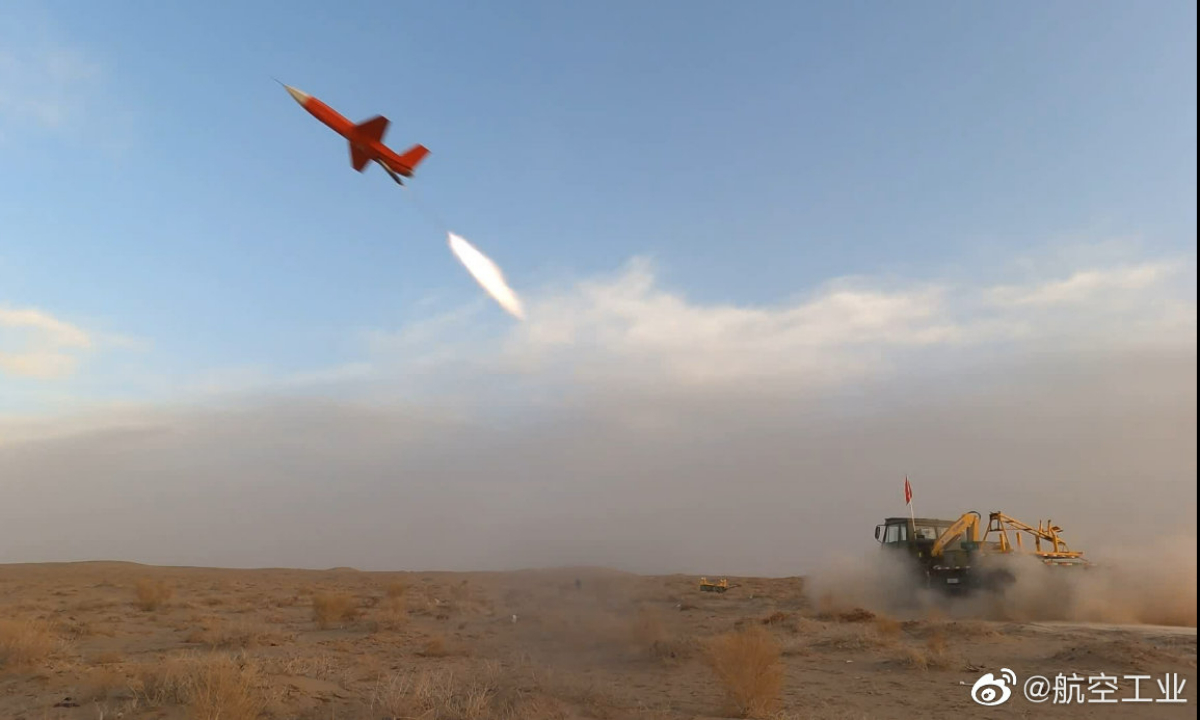
China launched a solid-fuel rocket from mobile sea platform 

 https://spacenews.com/china-launches-14-satellites-with-new-solid-rocket-from-mobile-sea-platform/

China recently carried out the maiden flight for a type of new high-altitude, high-speed demonstrator drone, which can ...

HELSINKI — China launched its new Jielong-3 rocket from a mobile sea platform in the Yellow Sea Friday, successfully sending 14 satellites into orbit. The Jielong-3 (“Smart Dragon-3”) lifted off at 1:35 a.m. Eastern (0635 UTC) Dec. 9, from the Tai Rui modified barge off in the Yellow Sea. 


Thursday, 20 October 2022

China’s quality development is profoundly smooth, steady


China's economy is stable and on the rise.

During the ongoing 20th National Congress of the Communist Party of China (CPC), an official in charge of the National Development and Reform Commission said at a press conference that judging from the current situation, China's economy rebounded significantly in the third quarter, and from a global perspective, China's economic performance is still remarkable. Although affected by changes in the domestic and external environment, there are still some outstanding contradictions and problems in the current economic operation. However, China has a population of more than 1.4 billion and coupled with basic conditions such as a complete industrial system and a comprehensive industrial chain, "China's economic stabilization and improvement will be further consolidated."

We have noticed that the assessments that some well-established international agencies made recently on China's economy coincide with China's own remarks. A well-known consulting agency said that most preliminary economic data indicated that China's economy recovered in the third quarter. Experts from the Economist Intelligence Unit also believe that compared with the economic difficulties of various countries in the world, "China has some unique advantages at the moment," which enables China's economy to maintain positive growth even when faced with great internal and external pressure.

Of course, when people pay attention to and discuss China, there are also negative and pessimistic arguments, and some even regard China's development and security, government and market, openness and independence as contradictory to each other. Part of it comes from taking wishful thinking as fact, because it has long been "standard configurations" for some US and Western public opinion to downplay China; at the same time, part of it results from looking at "speed" with the outdated thinking and vision, without understanding the deep logic of China's high-quality development.

If we observe the Chinese economy from the perspective of quality development, we will look through the complicated and indistinguishable superficial information to see the ongoing evolution and the improvement of the Chinese economy. In recent years, although the growth rate of China's economy has declined a bit compared with some periods in the past, its economic structure has been continuously optimized and its development momentum has been enhancing. In particular, the development speed of high-tech industries is equal to doubling the average development speed of the entire industry. Some major technological fields have made their ways to the global frontier, transformed by innovation-driven factors instead of the factors such as land, capital and labor in the past. At the same time, the energy consumption per unit of GDP has continued to decline. The sky is bluer, the mountains are greener, and the water is clearer. Although facing some temporary challenges and difficulties, China has enhanced its ability to overcome difficulties in its economy. 

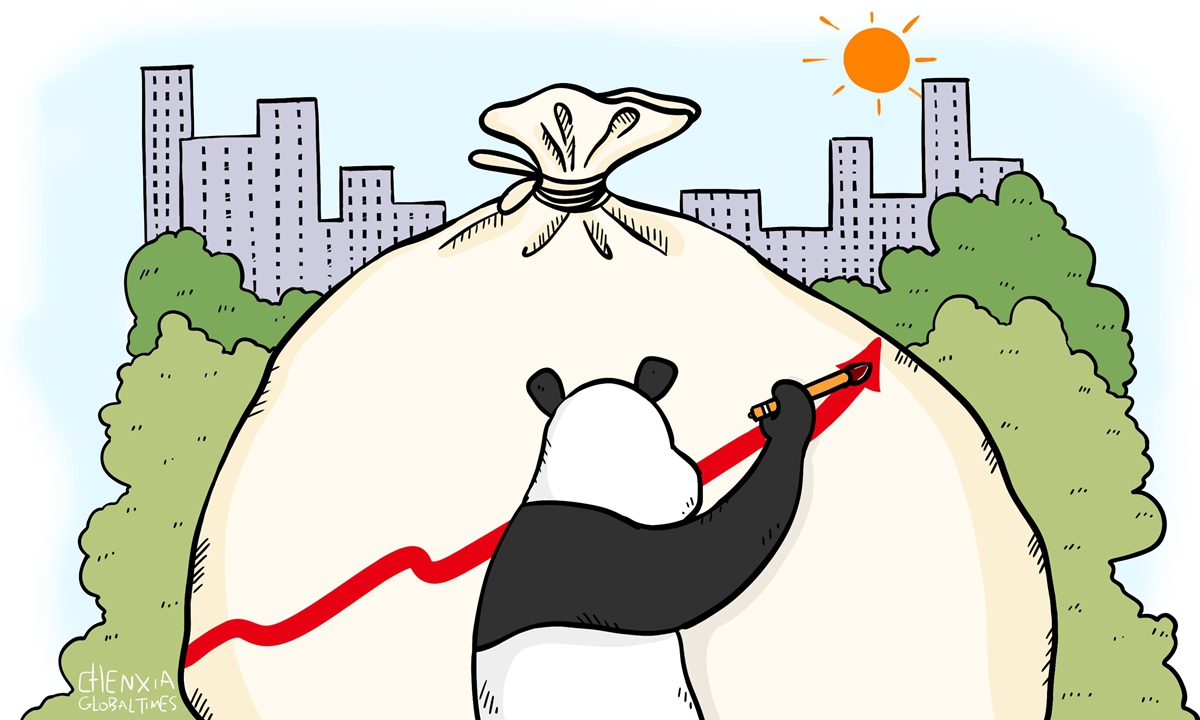
Illustration: Chen Xia/GT

Illustration: Chen Xia/GT 

The report to the 20th CPC National Congress stressed that "To build a modern socialist country in all respects, we must, first and foremost, pursue high-quality development." If the Chinese people are to live a better life and the Chinese nation is to realize its great rejuvenation, maintaining economic growth is of course very necessary. At the same time, the Chinese people have a broader and more comprehensive understanding of growth. And high-quality development is a new concept in which "innovation is the primary driver, coordination is an endogenous trait, eco-friendly growth prevails, openness to the world is the only way, and shared growth is the ultimate goal." This is also China's proactive pursuit of following the laws of economic development, adapting to changes in major social contradictions, and maintaining sustainable and sound economic development.

Compared with the past, China now puts more emphasis on maintaining national security, because the global security situation today has become more complicated, especially when the US is fanning flames and creating geopolitical crises everywhere and treating China as its No.1 strategic competitor. Against the backdrop of a sudden increase in external risks and a more insecure world, where can development come from without the overall favorable environment of national security? Some US and Western public opinions have deliberately put development on the opposite side of security, simply because in their hearts, they do not want China to be secure, nor do they want China to grow and develop.

The giant ship of China has always pointed to a determined direction, never going off its course nor turning around. In the new era, the CPC, in accordance with the changes in reality at home and abroad, has taken precautions and foresight to extend and develop the experience summed up in the past decades, and then has established a new development concept and strategic plan, which is coherent and consistent with the past development direction.

One thing that is absolutely certain is that China cannot copy the Western model for its development, and anyone expecting China to follow that path is bound to feel disappointed and will complain that "China has changed." But in fact it's not China that has changed. Instead, it is that they have made a wrong judgment from the very beginning; it can even be said that those who have been bad-mouthing China are disappointed, which just shows that China has done the right thing.

Although China is already the second largest economy in the world, its per capita income is still far behind that of developed countries, which means greater economic growth space.

Implementing the spirit of the report to the 20th CPC National Congress, insisting that development is the "first priority" and high-quality development as the "primary task," we have ample reasons to maintain confidence in the Chinese economy. 

Source link 


RELATED ARTICLES: